
Beijing is outlawing the provincial free-for-all that made PRC exporters a force global markets are still absorbing
An unusual cluster of commitments on a single theme features in the 2026 Government Work Report. For the first time, Beijing has pledged to enshrine its unified market campaign in statute. Alongside this, the report calls for two national lists that explicitly define what local governments may and may not do to attract investment. It also calls for deeper procurement and bidding reform, capacity controls, standard-setting, and quality regulation to tackle ‘involution-style’ competition across overcapacity sectors.
These commitments share a common thread. They all target how local governments behave, not merely what they report.
compliant on paper
The agenda addresses a problem that has accumulated over decades of fiscal decentralisation. Local governments, dependent on land sales and investment attraction for revenue, built an elaborate architecture of local protectionism: hidden barriers to cross-provincial factor flows, preferential treatment for local champions, and subsidy regimes that distorted resource allocation.
Almost every industry, new and traditional alike, was being built simultaneously across dozens of provinces, each shielding its own entrants. Industries requiring sustained cross-regional coordination, advanced semiconductors being the obvious case, were starved of both capital and scale. Calling out this practice Jiang Xiaojuan 江小涓 China Society of Industrial Economics president, argued in 2024 that at China’s current scale, growth means deploying what already exists more efficiently, not building more of the same. Such growth requires consistent rules, fair competition, and firms that can actually fail. Local protectionism and endless bailouts rule out all three.
Beijing’s April 2022 ‘Opinions on accelerating the construction of a nationally unified market’ diagnosed this directly and moved to dismantle it. What followed was concerted activity: roughly 690,000 local policy measures were reviewed, 4,218 identified as problematic, a ‘Fair competition review regulation’ enacted, and the market access negative list trimmed.
What was actually happening told a different story. Explicit preferential policies disappeared from official documents; their effect did not. Public vehicle fleet renewal favoured locally-produced brands. Government informatisation contracts flowed to locally-established state-backed platforms that outside firms could not contest. Explicit subsidies, prohibited under the 2022 rules, re-emerged as industrial guidance funds taking equity stakes, or local state entities building factories and leasing them back to target firms. None required a policy document or fell within the scope of fair competition review.
The Party’s own verdict came in the July 2024 Third Plenum communiqué: local protectionism and market segmentation, it acknowledged, ‘persist despite repeated prohibitions’—lǚ jìn bù zhǐ (屡禁不止).
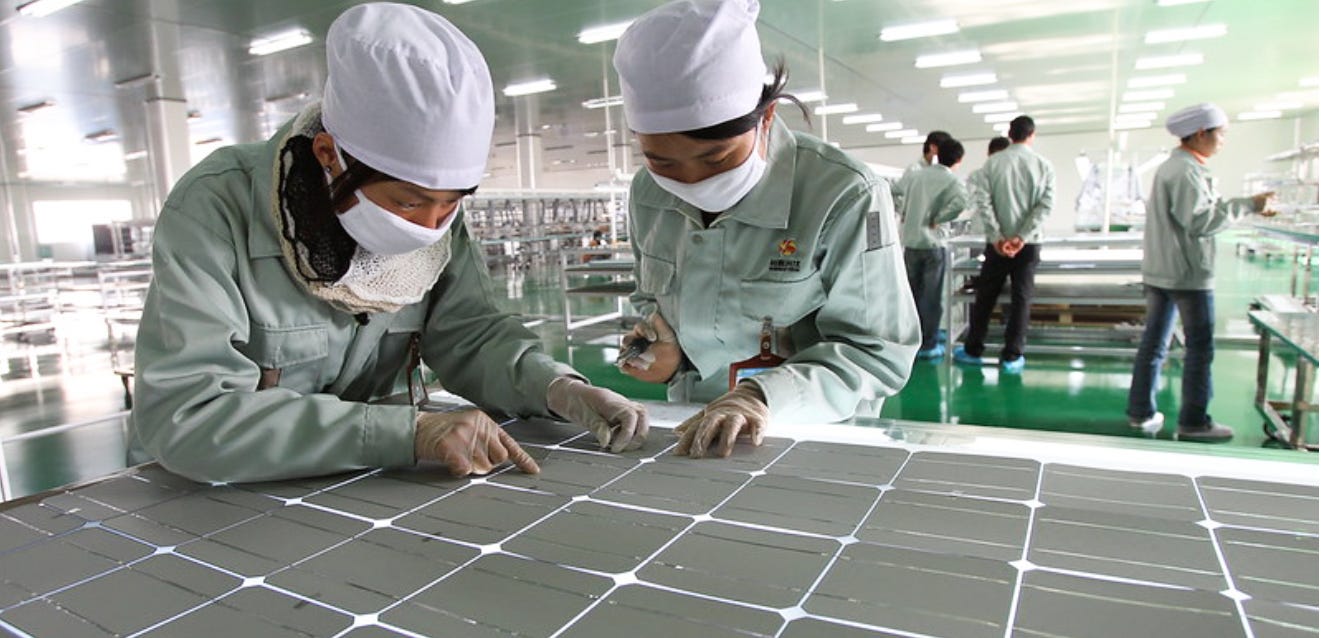
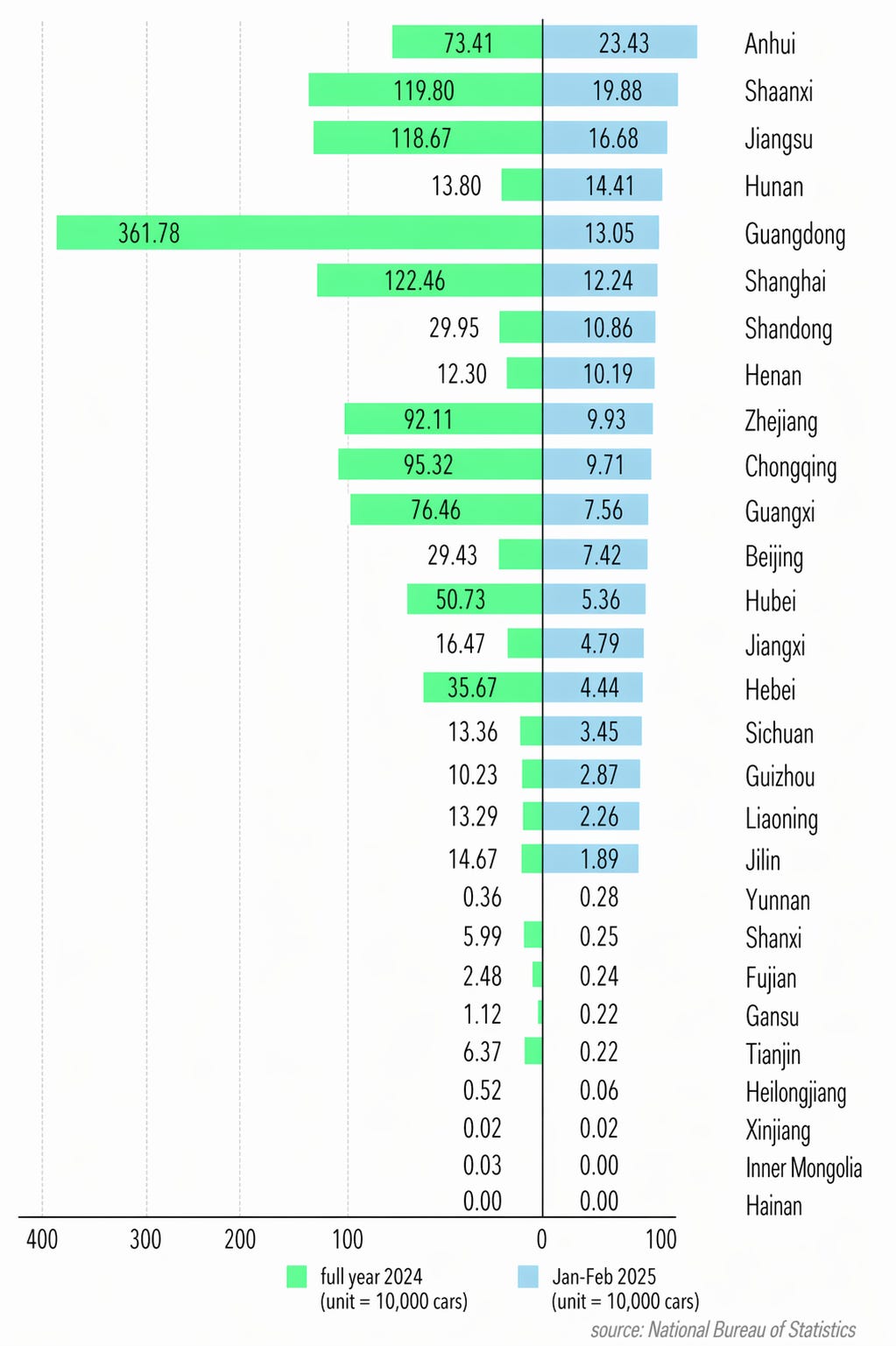
The consequences were not long in coming. With land revenue collapsing and no alternative fiscal model in sight, competition for the remaining pool of attractive investment intensified. As the economy matured, local governments had stopped competing in ways that drove growth and started competing in ways that undermined it. They were hoarding resources, duplicating industries, and undercutting each other in a race to the bottom, in the view of Zheng Yongnian 郑永年 Chinese University of Hong Kong (Shenzhen). More than 80 NEV (new energy vehicle) production bases spread across 27 provinces, loss-making local brands sustained by provincial procurement mandates, and with capacity running at 20–30 percent. Solar module capacity reached multiples of global demand of 450–500 GW; prices fell over 60 percent from 2022 peaks; the industry fell into collective loss. Beijing labelled it ‘involution’: a word that had migrated from social commentary into official economic diagnosis.
Through a series of high-level meetings in 2025, culminating in the Central Economic Work Conference in December, Beijing shifted from ‘accelerating’ to ‘deepening’ unified market reform, formally embedding anti-involution measures and overcapacity reduction within the framework.
NEV production units of each province
from campaign to statute
Three sets of measures are central to Beijing’s approach to the problem: the legal foundation, the closure of loopholes, and the assault on involution.
The reform has always lacked a legal foundation. Prior cycles operated through policy documents that local governments could nominally comply with while adapting around. Enshrining the campaign in statute changes the calculus. Violations become legally actionable rather than administratively negotiable.
Prior rules consistently left loopholes open. Banning explicit subsidies without specifying their replacement redirected local creativity toward functionally identical alternatives. Two national lists, one defining permitted and prohibited investment promotion, the other updating the market access negative list, close the substitution space that local governments have exploited since 2022 by defining instruments explicitly rather than by category. The ambition is to narrow the room for local workarounds. For too long, distorted incentives have fuelled a race to the bottom, and fixing the underlying structures that drive this destructive competition has now become a necessary condition for restoring prices, profits and confidence, argues Zhang Jinjie 张金杰 Chinese Academy of Social Science Institute of World Economics and Politics and Committee for Economic Affairs.
The assault on involution is the most operationally ambitious
NEVs: capacity controls and standard-setting targeting the provincial procurement mandates that have kept loss-making local brands alive
PV: price enforcement and quality regulation across a sector whose collective losses have made it the starkest example of involution in action
Clearing the chronic backlog of overdue payments to enterprises runs across both sectors and beyond.
reclaiming authority
The 2026 measures aim to reclaim authority and set the rules to enforce it. Beijing has directly assumed industrial policy decision-making power that previously resided with local governments. New projects in strategic sectors, NEVs, solar, energy storage, and semiconductors, now require central approval from NDRC; local governments no longer hold autonomous approval rights. Since late 2025, over 100 projects with combined investment exceeding C¥500bn have been halted by central authorities.
Statistical reform moves toward recording economic activity where it occurs rather than where firms are registered, removing the incentive for localities to poach registrations from places where the actual work happens.
Local governments are being repositioned from architects of industrial policy to implementers of centrally-determined priorities, from ‘development-driven government’ to ‘service and maintenance agencies.’
a structural reckoning
If Beijing sustains the current trajectory, the likely outcome is structural divergence. Localities with real industrial depth will consolidate their advantages as capital and talent concentrate where returns are highest. Those without, the majority of inland and lower-tier cities, will settle into their natural role: what the official framing calls ‘guaranteeing basic livelihoods, wages and operations’, sustained by central transfer payments that reached C¥10.42tn in 2025, with some western provinces already drawing over 70 percent of fiscal resources from the centre. Central transfers, in effect, become their development model.
The reform repositions local governments as service providers, a role the centre is now, for the first time, explicitly endorsing. In large economies, population and resources tend to concentrate where productivity is highest. The institutions Beijing is now building point in the same direction. It is also building the regulatory and credit infrastructure to back this up.
Beijing is promising to dig deep into its pockets. Through a unified national social security system, expanded transfer payments and ultra-long-term special treasury bonds, the centre is building a cross-regional safety net to ensure baseline public service provision, absorb local fiscal stress and contain the social stability risks that come with provinces settling into their natural floor.
The practices Beijing is now moving to outlaw, subsidy races, provincial protectionism, ruinous capacity competition, are the same ones that turned PRC exporters into a force global markets are still absorbing. The 2026 reforms are a bet that the country has outgrown the model that built it.
market experts
Zheng Yongnian郑永年 | director The Chinese University of Hong Kong, Shenzhen Advanced Institute of Global and Contemporary China

Zheng argues that the main barrier to building a unified national market lies in administrative fragmentation rather than in firms. He says the PRC’s dense, multi-layered administrative structure has produced segmented internal markets, explaining why the economy is often described as ‘mayor-led’ rather than market-led. To address this, he calls for deeper administrative reform: reducing redundant layers, cutting policy-induced barriers, and shifting government from direct economic intervention toward rule-based regulation and service provision. In his view, building a unified market ultimately depends on giving firms greater room to operate across regions under more consistent rules.
He also links this agenda to broader high-level opening, arguing that the PRC should better align with international rules and standards while expanding its own role in rule-setting. At the same time, he suggests market integration is likely to proceed gradually, with regional common markets serving as stepping stones toward a fuller national market.
Zheng has built a distinguished academic career spanning China, the US, and Singapore. After a stint as a lecturer at Peking University (1988–90), he began his long affiliation with Singapore, first as a Research Fellow at the East Asian Institute from 1997 to 2005. He then briefly served as the Founding Research Director of the China Policy Institute at the University of Nottingham (2005–08), before returning to lead the EAI at the National University of Singapore as its Director from 2008 until 2020. Zheng is recognised as an influential scholar and public commentator on PRC governance and geopolitics. He holds an MA in Political Science from Peking University and a PhD in Political Science from Princeton University.
Lu Ming 陆铭 | CPPCC National Committee member, Shanghai Jiao Tong University Antai College of Economics and Management professor
Lu’s core insight is that the economic case for market integration strengthens as an economy matures. In later stages of development, regional integration delivers meaningful gains, raising GDP and welfare, supporting structural transformation and deepening the division of labour across regions. But as producer services become more sophisticated and more deeply embedded across sectors, the benefits of nationwide integration begin to outpace those of regional arrangements. As sectoral linkages multiply and deepen, the cost of market fragmentation rises with them. For Lu, this dynamic gives the push toward a genuinely unified national market, increasing urgency the further China’s economy develops, making it a condition for sustaining growth.
Lu is a distinguished professor at Shanghai Jiao Tong University’s Antai College of Economics and Management and executive dean of its China Development Institute. His research spans urban and regional development and labour economics, with a particular focus on applying spatial political economy to questions of domestic market integration and long-term growth.
Sun Jin 孙晋 | Wuhan University Law School professor
Sun argues that involutionary competition is a compound problem: state distortions and market dysfunction reinforce each other, pushing firms into cycles of low-price, low-quality rivalry and redundant production that delay the industrial upgrading the PRC needs. The root cause, in his view, is institutional. That is where the fix must begin. Correcting it requires disciplining government behaviour and ensuring local policies align with national priorities, rather than pulling against them. He calls for a dedicated legal framework: new legislation on building a unified national market, a revised Price Law, and more muscular antitrust enforcement.
The logic is that without a rules-based foundation, administrative instructions alone will not hold. Looking to 2026, he argues that progress depends on both ends moving together, government restraint creating the space for market forces to function, and market forces rewarding quality over volume. The destination, in his framing, is an economy that competes on upgrading rather than on scale.
A professor at Wuhan University Law School, Sun is director of its NDRC-affiliated Competition Law and Competition Policy Research Centre and executive dean of the Institute of Network Governance, where his research spans competition law, competition policy and internet governance. He has held practice-facing posts as vice dean of Xinjiang University Law School and at Zhenjiang Intermediate Court, and was a visiting scholar at UC Berkeley Law. Sun is vice chair of the China Commercial Law Research Association and a prominent voice on fair competition review and market regulation.
Beijing isn’t just cleaning up local protectionism — it’s reclaiming the right to decide where overcapacity ends and leverage begins.