
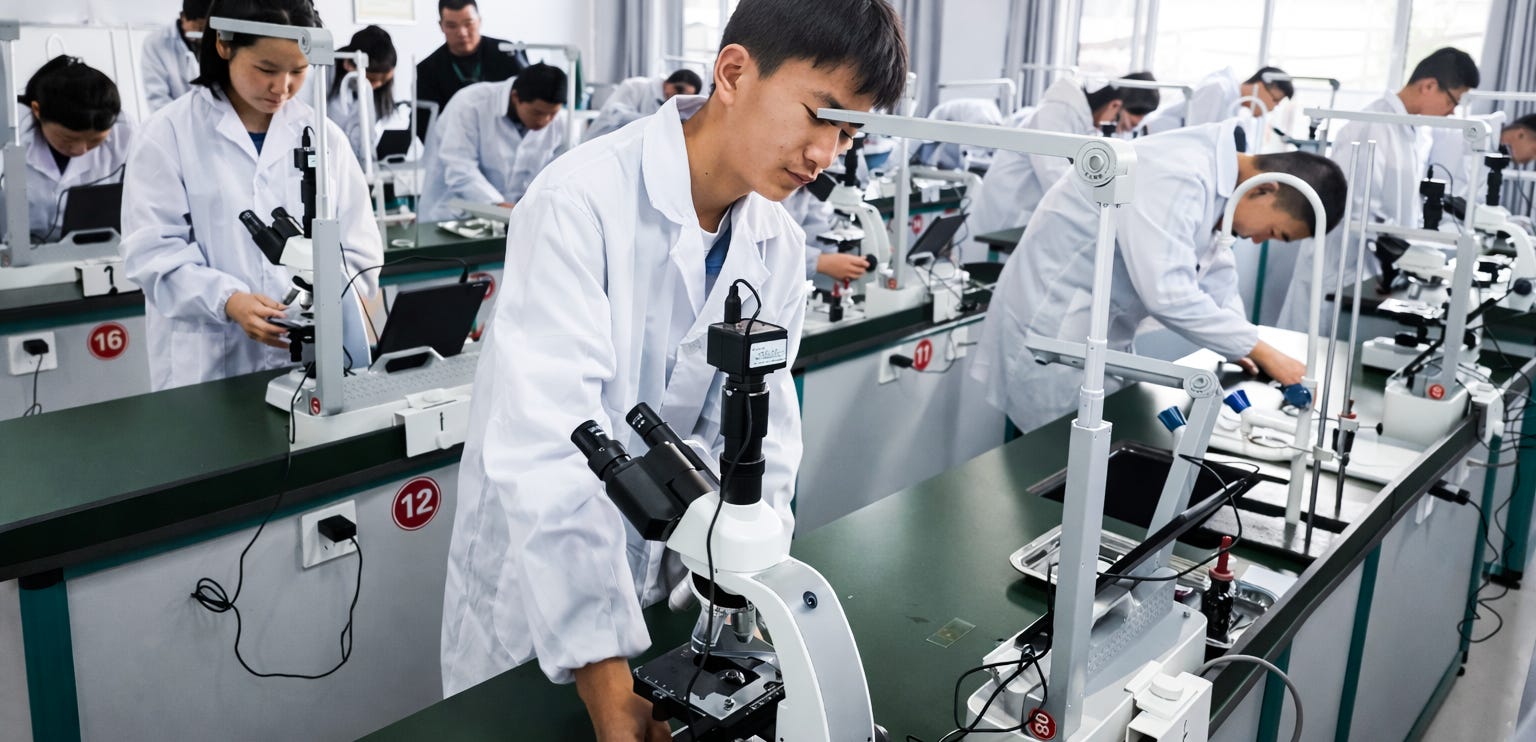
the latest wave of university expansion is surgically targeted—concentrating on strategic STEM fields within elite institutions, unlike the broad-based growth of the previous wave
China faces two countdowns: an economic transition that needs high-tech talent now, and a demographic collapse that will deplete university classrooms by 2040. The latest enrolment expansion tries to beat both clocks—turning out AI engineers and chip designers from a youth cohort that will not exist a generation from now.
Expanding higher education has re-emerged as a policy priority. At the 2025 Two Sessions, the Government Work Report called for advancing quality undergraduate expansion. The Central Economic Work Conference in 2025 urged a reorganisation of educational resources, including adding capacity in regular high schools and broadening access to quality undergraduate programs.
Unlike the mass expansion of 1999, when university admissions doubled within a single year, the 2025 initiative is measured and selective, focused on ‘double first-class’(top) institutions and disciplines aligned with PRC strategic industries.
innovation and consumption
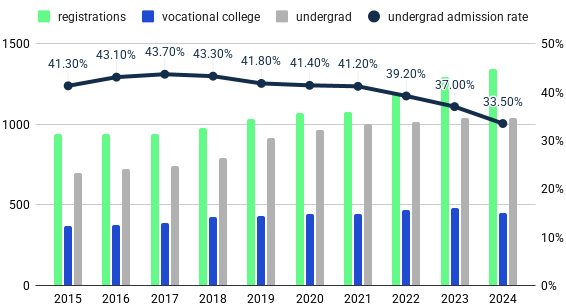
Gaokao (university entrance exam) registrations have topped 10 million each year from 2019–24, reaching ~13 million in 2024. Still, the undergraduate admission rate has dropped from some 41 to 34 percent, while ‘double first-class’ quotas have barely grown. Quality undergraduate places remain scarce and highly contested.
gaokao registration & admission data (2015–24)
The pattern repeats from the 1990s. China faces no financial crisis, but transitioning to a high-tech, consumption-led economy takes time, complicated by the aftermath of COVID. Expanding enrolment injects spending into universities and surrounding businesses while postponing job-market entry for unemployed youth. Vocational schools, meanwhile, upskill technical workers.
As of 2025, Beijing calculates that since the early days of the People’s Republic, over 250 million have graduated from university; expansion has built a large, high-quality workforce that underpins scitech innovation, economic growth and social progress, remarked Ding Kuiling 丁奎岭 Chinese Academy of Sciences.
targeted expansion
This round has a sharp focus. Earlier expansion essentially lifted total enrolments without much regard to majors; ‘quality undergraduates’ now signals a quantitative and structural shift, argued Wang Feng 王烽 National Institute of Education Sciences. Beijing frames the current round as a marginal adjustment, not a full-scale ‘enrolment expansion’.
Quality undergraduate places make up about 15 percent of all tertiary enrolments (including vocational schools), and most of them have only grown between 1-5 percent since 2024, noted Chu Zhaohui 储朝晖 National Institute of Education Sciences. This is designed to fine-tune the talent mix rather than flood the market with new graduates.
Unsurprisingly, the expansion this time is aimed at foundational disciplines, interdisciplinary work and emerging fields. Future talent investment must rise in AI, integrated circuits, new energy and biomedicine to meet innovation and industrial upgrading needs, urged Ding Jianning 丁建宁 National People’s Congress and Yangzhou University.
expansion priority
With its focus on ‘specialised majors + priority fields’, this round centres on two main themes
development trends in ‘emerging engineering disciplines’, industries and business models
interdisciplinary studies and skilled workforce cultivation
In 2025, top universities, such as Tsinghua University, Peking University and Shanghai Jiao Tong University, each added 150 undergraduate places, mainly in emerging engineering fields like AI, integrated circuits and new energy. These specialisations serve national strategy and align with emerging industries in many cities.
Humanities places are being cut: Fudan is reducing the liberal arts share of its intake from 30–40 percent to 20 percent. The backdrop is the declining share of science and engineering graduates, explained Ding Yanqing 丁延庆 of Peking University. STEM’s proportion of graduates dropped from some 67 percent to 48 percent between 1998 and 2019.
This near one-to-one balance between STEM and the humanities from around 2019 was never intended in a state that puts technology above all else, while weak economic alignment has left humanities graduates with poorer career prospects. From the standpoint of national strategy and market demand, raising STEM intake and cutting humanities places in higher education has become imperative, Ding argued.
stretching the demographic dividend
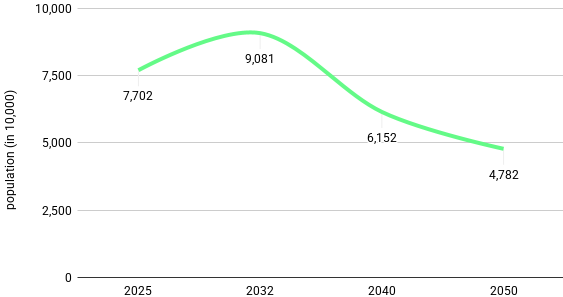
Demography marks another major break with the 1990s. Continuing population decline, above all among younger cohorts, has led to primary school enrolment peaking in 2023, but the higher education school-age group will keep growing until about 2032. That gives higher education roughly ten more years of golden growth before a sharp decline. Some universities may face a survival crisis as the pool of applicants shrinks, Guangxi Normal University warned.
Expanding STEM majors in top universities is also a race against time. Beijing wants to bring in as many young people as possible before numbers decline, locking them into disciplines that serve strategic sectors. The current expansion tries to catch the last train of the demographic dividend by reshaping who studies what, and where.
higher education age-eligible population from 2025–50
navigating expansion
Wang cautioned that enrolment expansion does not automatically lead to quality improvement, particularly in interdisciplinary and emerging disciplines, which require sustained investment in faculty, research teams and supporting infrastructure. Wang said expansion should proceed gradually, with improvements in quality keeping pace with, or exceeding, increases in scale, echoing the Government Work Report’s emphasis on ‘steady’ rollout.
Chu sees uneven enthusiasm for expansion across universities and argues they should play to their strengths instead of chasing headcount. In the AI era, universities must also resist setting up fashionable majors without clear teaching capacity, research depth or demand. He warned that blind imitation could leave students in overhyped fields with weak training and poor job prospects.
looking ahead
Beijing’s report on higher education fiscal allocation notes that the school-age population destined for higher ed will move through three phases—rapid rise, brief plateau and steep decline—which will be hard for policymakers to manage
pre-peak challenges: heavy pressure for extra investment, as per-student funding, teaching facilities, student housing, staff, and other needs all rise together, while localities already report fiscal strain and difficulties securing funds for the coming years
post-peak challenges: fixed assets like teaching facilities risk low use as enrolment drops, while staff cuts are constrained by staffing quotas and other rules, making both blind expansion and large-scale downsizing unwise
With enrolment set to peak around 2032 and then fall sharply by 2040, managing pre-peak shortages and post-peak idle capacity will be critical. Policy so far still lacks a systematic plan to smooth that arc, even as this round of ‘quality’ undergraduate expansion begins to reshape the talent pipeline.
education experts

Chen Gang 陈刚 | Zhejiang University vice president
So-called ‘emerging engineering disciplines’ primarily relate to computer science. In AI, Zhejiang University’s School of Computer Science and Technology mainly collaborates with law schools, medical schools, education schools and economics schools rather than necessarily setting up dedicated majors.
For instance, the database course was not introduced because the field became popular—it was established 20 years ago. Beyond teaching database usage like regular institutions, we teach how to build databases. These skills are precisely what students require in today’s big data era.
In Chen’s view, Zhejiang University aspires to emulate Stanford University. Stanford’s relationship with Silicon Valley closely resembles Zhejiang University’s relationship with Hangzhou, he explained.
A Zhejiang University PhD, Chen specialises in cloud databases and real-time big data processing. He has served as Zhejiang University Computer Science dean and vice president, Zhejiang Key Laboratory of Big Data Intelligent Computing director and NetEase Hangzhou Research Institute founder, advancing academia-industry integration.

Xiong Bingqi 熊丙奇 | 21st Century Education Research Institute deputy director
Some provinces are intensively expanding ‘double first-class’ universities to address higher education shortfalls, but this requires substantial funding and creates critical challenges.
An ‘expansion wave’ could dilute quality resources and exacerbate the degree of elitism, leading students and parents to chase prestigious institutions for status rather than educational quality. More critically, as the student population declines after peaking around 2032, expanded campuses built with billions in investment could become idle within a few years, triggering waves of closures at other institutions and creating a structural imbalance.
The PRC could achieve 100 percent undergraduate education by 2041, but degree devaluation and credential inflation would become pervasive problems. The solution requires moderate expansion of quality institutions while prioritising differentiated development, encouraging each institution to strive for distinct positioning, and building a sustainable, high-quality higher education system.
21st Century Education Research Institute in China deputy director, Xiong, promotes the importance of aligning educational practices with the evolving needs of society, particularly in light of technological advancements and demographic changes. Xiong is an expert in education policy and reform and has written extensively on issues such as educational reform, vocational education and the role of education in societal development.

Bao Xinhe 包信和 | University of Science and Technology former president and academician
This expansion addresses an approaching student wave—2016 births peaked at around 18 million, projecting a higher education enrolment surge around 2033. Currently, ‘double first-class’ and other top universities admit approximately six percent of students; without expansion, this proportion would decline substantially, limiting access to quality education for a larger population.
However, expansion, particularly in lab-dependent science and engineering courses, demands adequate infrastructure. Chemistry students require individual workstations and fume hoods for safe experimental training; physics students need access to large equipment. Increased enrolment intensifies equipment availability pressures and creates timing constraints for hands-on learning.
Universities must secure necessary facilities before expanding to maintain training quality. Moreover, these prestigious institutions will remain highly sought after even after the demographic wave subsides, thereby avoiding future recruitment difficulties or underuse of resources. The challenge lies in balancing immediate accessibility with long-term quality assurance through strategic infrastructure investment.
Chinese Academy of Sciences academician and University of Science and Technology of China former president, Bao Xinhe, champions innovative approaches to energy catalysis and carbon-neutrality research. He is a strategic scientist who pioneered the internationally recognised ‘nano-confinement catalysis’ concept. Bao is an expert in physical chemistry and catalysis, leading frontier research in quantum technology, AI and carbon-neutral solutions, whilst advancing elite university development and science-education integration as a National People’s Congress Standing Committee member.