
PRC economists have stopped asking whether the economy is dividing; the live argument is what is holding the lower arm down, and each answer sends policy to a different desk
Once a description of uneven post-pandemic recovery, the notion of a K-shaped economy has become shorthand for PRC macro debate, turning up everywhere in commentary on the economy’s direction. The argument now turns on what is driving the divergence, and therefore what policy should do about it.
becoming a key macro frame
‘K-shaped recovery’ entered the global vocabulary during the 2020 pandemic, describing parts of an economy moving in opposite directions after a common shock. US economists took it up from mid-2020 for widening gaps across industries, firms and households.
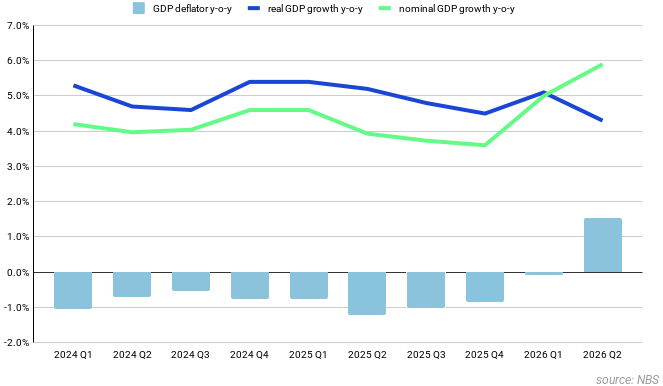
It is not new to the PRC either. PRC economists used it during the 2023 reopening to describe a consumer recovery concentrated among particular groups, but it remained descriptive. Q2 2026 gave it force: prices rose for the first time since mid-2023, ending three years of deflation, and nominal growth (not adjusted for inflation) accelerated to 5.9 percent even as real growth (adjusted for inflation) slowed to 4.3 percent, while investment stayed weak and household demand barely moved.
AI-related activity may explain part of this unusual combination, argues Guo Kai 郭凯 CF40 (China Finance 40 Forum) Institute: AI-linked exports, output, revenue and profits are running ahead of aggregate growth, while investment in software, data and computing is poorly captured by conventional fixed-asset indicators.
CMF (China Macroeconomy Forum) devoted an 11 July seminar and report to ‘the nature and governance of the current K-shaped divergence’, turning the label into a macro frame. What it frames is a disagreement over what is holding the wider economy back, and the answers point to different policy desks.
The most sceptical reading questions the K itself. The economy is running cold overall and the rising arm remains too small to pull it forward, argues Li Daokui 李稻葵 Tsinghua University Academic Centre for Chinese Economic Practice and Thinking. For Li, dividing activity into rising and falling sectors risks obscuring a broader macro blockage.
That challenge sets the stakes for the debate: is weakness below the cost of transition, a failure of gains to spread, or evidence that the economic circuit itself needs repair?
headline reflation without demand recovery
one frame, many divides
Part of the disagreement comes from what economists mean by the K. This analysis follows the sectoral version, new industries against old, because it is the one closest to how officials describe the transition and shapes the debate below, though it is not the only lens available.
The sectoral reading has gained traction because it fits Beijing’s language of structural upgrading and new productive forces. Official discussion of H1 2026 performance repeatedly described the economy as ‘moving towards the new and improving in structure’.
Beijing’s own frame centres on ‘stability’. Growth speed alone does not determine economic health, argued People’s Daily on 11 August under its Zhong Yin 仲音 authoritative byline: 4.7 percent sits within a reasonable range so long as employment, firms, markets and expectations hold steady. Read that way, divergence is not a split to be closed but a transition to be kept stable.
The contrast is revealing: in February, Xinhua reached for the term to diagnose US wealth inequality, while top-level language for the PRC’s own economy runs through transition and upgrading instead. That does not make K an off-limits domestic term. It shows how the same pattern acquires different meanings depending on what is understood to be diverging. The K describes divergence. It does not explain it.
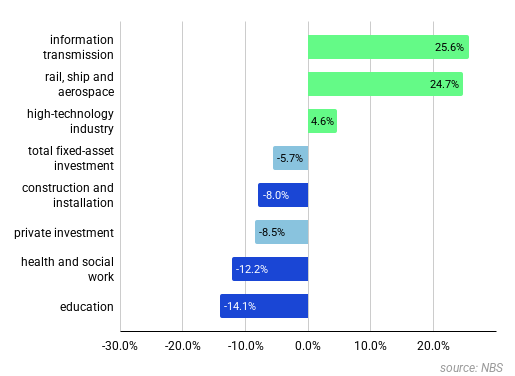
Fixed-asset investment shows the split most clearly. Information transmission and advanced transport equipment rose sharply, while construction, health and education all fell faster than the total. The last two are funded from local budgets that have been contracting in the same year Beijing named livelihood provision a priority. Health and education are funded from local budgets that are shrinking with property revenue. Some of what looks like sectoral divergence is fiscal.
tech investment climbs as local budgets fall away
measuring the rising arm
Even the dominant sectoral reading runs into a basic problem: the rising K has no agreed boundary. NBS (National Bureau of Statistics) terms ‘three new’ 三新 activities, covering new industries, business forms and business models, at 18.39 percent of GDP in 2025. A narrower digital economy series put core digital industries at 10.5 percent in 2024. A preliminary estimate credits high-end manufacturing, the digital economy and modern services with over 40 percent of H1 2026 growth. None defines an AI economy or maps neatly onto the upper arm.
The measures nevertheless establish that new activity is already sizeable. The harder question is how quickly it can take over the functions of what is shrinking, and the broadest official measure gives a horizon rather than a verdict: the ‘three new’ share of GDP rose 0.38 percentage points in 2025, measured at current prices in a year when prices were falling.
Property and local infrastructure used to do several jobs at once, generating output and employment, creating household wealth and collateral, supporting land revenue and producing bank credit demand. Their contraction therefore leaves more than a GDP gap: it weakens the balance sheets (what is owned measured against what is owed) of households, local government and banks at the same time.
Li Daokui’s challenge becomes more concrete when the focus moves from sectors to balance sheets. The main blockage sits in local government finance, in his account: new borrowing increasingly rolls over old liabilities, while fiscal stress suppresses investment and drains company cash flow through arrears and tighter collection. Local governments that once transmitted finance into construction, employment and demand can instead absorb liquidity without generating comparable new activity. Parts of the lower arm are therefore being pulled down by balance-sheet pressure rather than displaced by more productive industries.
the new economy’s GDP share is growing, just not quickly
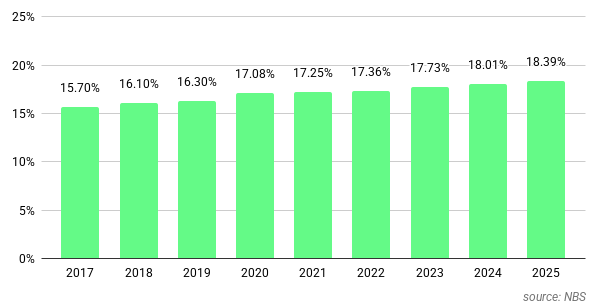
The broadest official measure of the new economy has grown by less than three percentage points of GDP over eight years. Replacement on that arithmetic is a matter of decades.
how the diagnosis shapes policy
The same K can support almost opposite policy conclusions, depending on the diagnosis.
If new growth is simply too small, the weakness below becomes an argument for accelerating transformation: more finance, investment and policy resources towards AI, advanced manufacturing and other new drivers until they carry more of the economy. The frame can therefore reinforce an existing tendency to concentrate resources where growth is already strongest. Targeted industrial and monetary tools risk deepening the split when they disproportionately reach sectors already expanding, warns Liu Xiaoguang 刘晓光 Renmin University of China National Academy of Development and Strategy.
If the problem is transmission, the task changes. More frontier capacity matters less than widening its footprint: bringing private suppliers into expanding value chains, spreading equipment and software through traditional firms, converting productivity gains into wages and consumption. New industries need not replace property one-for-one if the demand, technology and income they generate spread into the rest of the economy, argue Cheng Shi 程实 and Xu Jie 徐婕 of ICBC (Industrial and Commercial Bank of China) International: the K records a difference in speed, not two economies fated to stay apart.
Cheng and Xu’s own test is telling. H1 exports rose 13.4 percent, led by 20.1 percent growth in machinery and electronics, yet private investment fell 8.5 percent and retail sales grew only 1.3 percent. Disposable income rose faster than consumption, 5.2 percent against 3.7 percent, income accumulating rather than being spent. On their own evidence, the channels linking exports to domestic demand and growth to household spending remain only partially open.
A balance-sheet reading moves the desk further. If debt rollover, property losses and weak local cash flow suppress activity across sectors, stronger transmission helps without removing the blockage, and more adjustment has to move onto the central balance sheet through debt restructuring, arrears clearance, property resolution, public services and household support.
a testable bet
The much-anticipated readout from the 30 July Politburo meeting leans towards a mixture of the first two readings, accelerating new growth drivers and improving how their gains spread through the rest of the economy, calling for stronger counter-cyclical adjustment, faster policy delivery and domestic-demand support. The implicit bet is that upgrading plus better transmission will gradually narrow the divide.
That bet is testable. If private investment, jobs, wages and local cash flow begin following new activity upwards, the K will more closely resemble a transitional phase. If strong production keeps coexisting with weak household and local balance sheets, Li Daokui’s more pessimistic reading gains weight: the upper arm may be healthy without being large or connected enough to warm the economy as a whole.
Each diagnosis points to a different balance between industrial policy, demand support and central fiscal intervention, continuing to prompt debates among economists over policy focus. The decisive question is therefore less how quickly the upper arm grows than what is holding the rest of the economy back.
If weakness below is misread as the cost of transition, policy can keep strengthening the upper arm while leaving the mechanisms of divergence intact. That risks postponing long-deferred reforms to income distribution, labour protection and social security that ultimately determine how widely the gains from new growth spread.
the sceptics
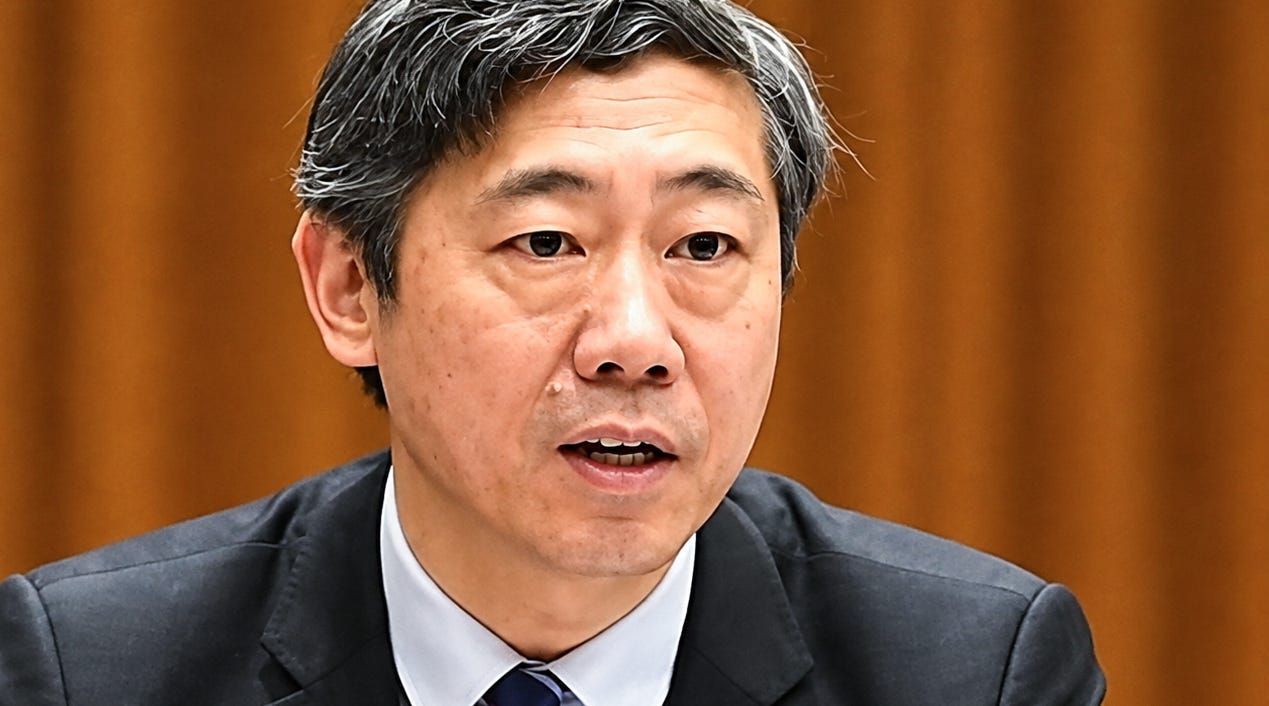
Li Daokui 李稻葵 | Tsinghua University Academic Centre for Chinese Economic Practice and Thinking director
The economy is running cold more broadly than the K-shaped economy frame suggests, Li argues. The rising arm remains unable to pull up the wider economy while local government finance has become a central blockage. New borrowing increasingly services existing liabilities instead of becoming investment, employment or income, weakening the transmission of finance into real activity.
Fiscal stress can also actively drain private-sector cash flow. Localities cut capital spending, delay payments, tighten tax collection and withdraw earlier incentives as their finances deteriorate. Li therefore puts more weight on the central balance sheet: cheaper central borrowing should replace part of local debt, while additional central funds support property adjustment, public services, urbanisation and household demand. His diagnosis turns the lower arm from the losing side of industrial transition into a fiscal-financial blockage that stronger new industries cannot repair on their own.
Li has long developed what he calls ‘government and market economics’, using the PRC reform experience to examine how government incentives, public institutions and markets interact. His book, Economic Lessons from China’s Forty Years of Reform and Opening-up, develops this wider research agenda. A Harvard PhD in economics (1992), Li taught at the University of Michigan and then returned to the PRC. A PBoC monetary policy committee member from 2010 to 2012, he has advised the World Bank on PRC social security reform. He is a professor at Tsinghua, a widely published pundit and on the Standing Committee of the Chinese People’s Political Consultative Conference.

Liu Xiaoguang 刘晓光 | Renmin University of China National Academy of Development and Strategy deputy dean
The current K reflects cyclical weakness colliding with a longer change in growth drivers, argues Liu. Future-facing sectors are expanding while larger parts of the economy that still carry employment, household income and current demand remain under pressure. Strength above therefore does not establish that the wider economy is recovering.
Liu’s sharper warning concerns policy allocation. Targeted industrial and monetary measures can direct resources successfully towards preferred sectors, yet may deepen the divergence when they disproportionately reach industries already expanding. Liu describes the risk as ‘taking from the insufficient to supplement the abundant’ 损不足而补有余. He therefore favours broader macro support reaching households, firms and weaker sectors alongside structural policy. His reading makes the K a question of policy distribution as well as industrial transition.
Liu is a leading contributor to CMF macro research and regularly presents its annual and mid-year reports. His academic work centres on macro-financial cycles, leverage and how financial structure affects growth and downturns. He holds a PhD in economics from Peking University and has worked as an IMF economist and ADB consultant.
context
30 Jul 2026: Politburo puts faster execution of existing funds ahead of any incremental package
30 Jul 2026: NBS puts ‘three new’ economy value added at 18.39 percent of GDP in 2025, up 0.38 percentage points
27 Jul 2026: Luo Zhiheng argues the new growth model is thinning the tax base faster than it generates replacement revenue
27 Jul 2026: CF40 Q2 report attributes the real-nominal growth gap partly to AI activity escaping conventional statistics
15 Jul 2026: H1 data show real growth of 4.7 percent, land sale revenue down 31.5 percent and property development investment down 16.2 percent
11 Jul 2026: CMF report and seminar turn the label into the organising macro frame of PRC debate
11 Jul 2026: Li Daokui argues the upper arm is too small and local fiscal blockage is the binding constraint
Jul 2026: Cheng Shi expects the split to narrow as upper-arm gains spread; Xiong Yuan frames it as a necessary stage
Jul 2026: Hu Xiaopeng argues consumption capacity should become the next target of public investment
Jun 2026: Yin Jianfeng carries the split into bank balance sheets, expecting finance itself to turn K-shaped
Feb 2026: Xinhua carries ‘K-shaped economy’ to diagnose US wealth inequality
Jul 2023: CF40 researchers describe a ‘K-shaped recovery’ sorted by income group, industry and region
Mid 2020: ‘K-shaped recovery’ enters the global vocabulary during the pandemic