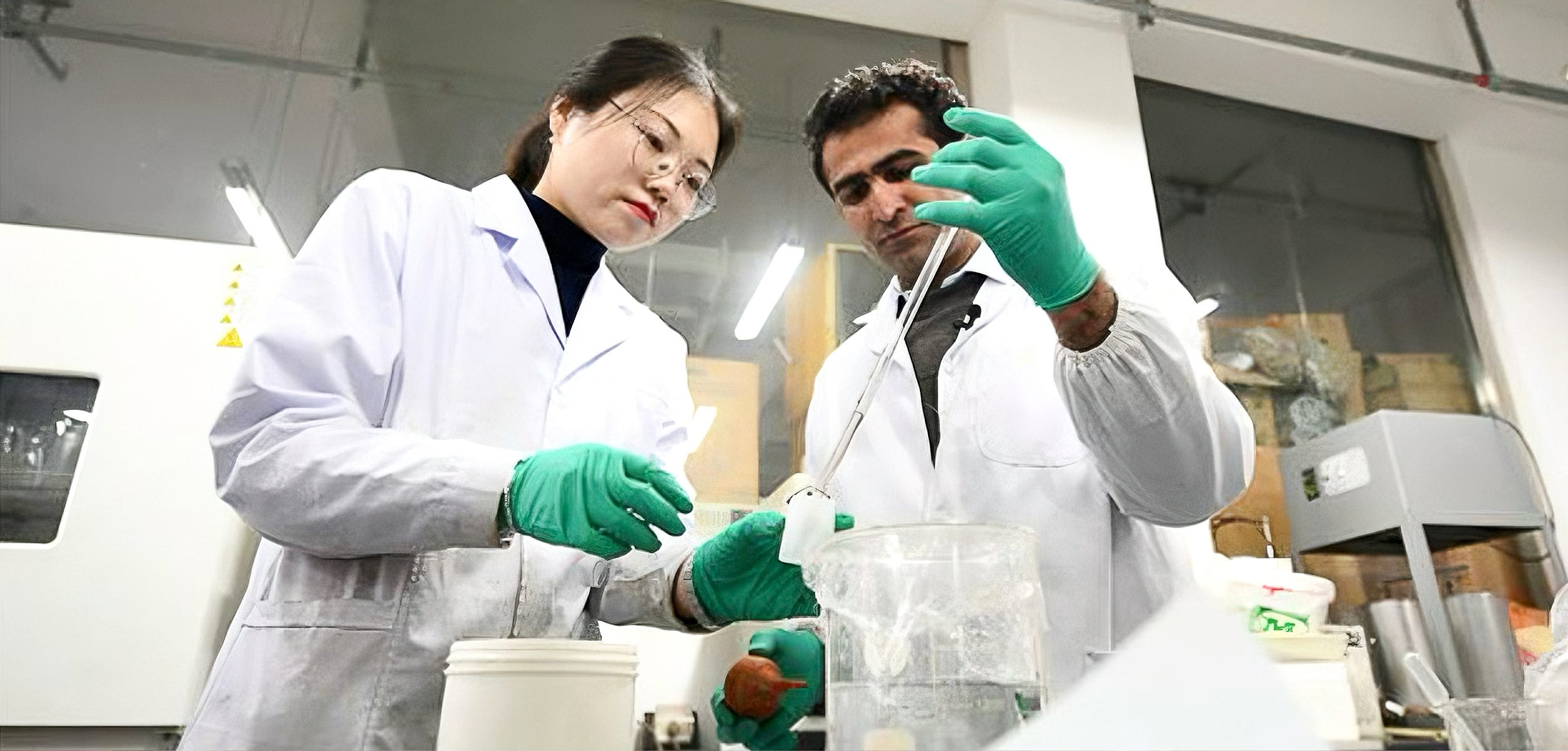
as old collaboration partnerships fray, Beijing is redrawing the map of global science—one research partnership at a time
Working across borders in education and research is now a priority for Beijing. The objective was set out in ‘Outline for building China into a leading country in education (2024–35)’ in January 2025, namely ‘expanding international academic exchange and educational research collaboration’. At the same time, to develop a wider domestic skills base, Beijing is also easing paths to jobs at home for academics and technicians who have worked or studied abroad.
external and internal push
The domestic drive to modernise and the push for greater global influence now work together shaping Beijing’s approach to education and research. As early as 2016, a demand gap for skilled workers of nearly 30 million by 2025 was foreseen by MoHRSS (Ministry of Human Resources and Social Security). But even with over 5 million STEM students graduating annually, a 48 percent shortfall is feared in key sectors like robotics and semiconductors in 2025. To fill the gap, Beijing is pushing for industry-academic alliances and vocational training.
This crisis in skilled labour intensifies as growth transitions from manufacturing- to innovation-led. Ever-higher quality STEM talent is at a premium that international collaboration may help address.
With crackdowns on US universities and MAGA-driven witch-hunts, Beijing's talent recruitment has boomed. The US Department of Justice's 'China Initiative' (2018–22), prompted two out of three Chinese-descent scientists to return to Greater China.
The PRC must open its education system wider, Xi told the Politburo in 2023, to become a globally influential education hub. Merging domestic tech imperatives, global governance ambitions, and geopolitical opportunity repositions global education cooperation (though not for the first time), from ornament to cornerstone.
find this analysis helpful?
research projects
Scientific partnerships had been signed with over 150 states and territories, by late 2024, underpinned by 118 cooperation agreements and membership in over 200 global organisations and multilateral mechanisms, reported Lin Xin 林新 a MoST (Ministry of Science and Technology) vice minister. Beijing spearheads the International Science and Technology Cooperation Initiative and the Initiative on International Cooperation in Open Science.
Research partnerships set up in 2025 transcend conventional scholarly exchange.
a National Natural Science Foundation partnership with Turkey expands to tumour immunotherapy, medical imaging, and sustainable agriculture
a PRC-Vietnam education cooperation agreement explores cooperation in AI, semiconductors, nuclear energy, and healthcare innovation IP protections
a joint PRC/Malaysia statement covers bilateral campus collaborations on AI, new materials, traditional medicine, vaccine developments, technology transfer mechanisms, etc.
a PRC–South Korea young scientists exchange program prioritises biotech, renewable energy, and climate adaptation: sectors aligning with both nations' industry strategies
a scientific infrastructure international cooperation research program between NSFC–CERN (National Natural Science Foundation and Conseil Européen pour la Recherche Nucléaire) allows PRC access to leading world labs and frontier research
Cooperation in quantum science and technology should step up, urges Ding Hong 丁洪 CAS academician. Making itself indispensable and ensuring mutual benefit, Beijing can address global challenges, without neglecting tech goals, and defining ’strategic’ collaboration on its own terms.
moving multilateral
Multilateral collaboration is also in play. New-era research alliances are less ad hoc than they appear; many are the downstream results of prior agreements, now folded into Beijing's broader strategic blueprint.
the BRI (Belt and Road Initiative) Science and Technology Innovation Action Plan is moving forward. By 2024, scitech agreements had been signed, over 50 joint laboratories set up, and collaborative networks woven in agriculture, renewable energy, etc., with over 80 BRI states.
the SCO Digital Education Alliance, officially launched during the May 2025 SCO Education Ministers’ Meeting, aligns with diplomatic pledges Xi made to the SCO+ Astana Summit in July 2024 of at least 1,000 training spots on digital technology. This also aligns with broader global digital education strategy
at the 2025 World Digital Education Conference in Wuhan, the MoE released a 'Smart Education White Paper', sketching plans for offshore digital learning centres, prioritise digital capacity-building in developing countries, and promote educational equity
a new China–Central Asia Industry–Education Alliance was announced in May 2025 at the first China–Central Asia Education Ministers’ Meeting, bringing Central Asia into the fold
Huai Jinpeng 怀进鹏 PRC Minister of Education called for Sino–Central Asia university collaboration in agriculture, healthcare, and energy at an education cooperation conference in May 2025
On the domestic side, a Xinjiang Academy for Advanced Studies has been announced. Housing a China–Central Asia Centre for Doctoral Training and Innovation, the institute will back Xinjiang’s strategic duty for ensuring national energy supply and innovating dryland farming.
These actions meet central calls for a new cycle of responsive innovation: firms raise research demands, the state sets priorities, universities design solutions, and it's back to the market for testing outcomes.
the politics of partnership
Burgeoning networks notwithstanding, collaboration entails challenge. Bureaucratic inertia is one source. Core administrative functions vital for international R&D approval are dispersed across multiple ministries, reports an NCSTE (National Centre for Science and Technology Evaluation) research team, with scattered departmental regulations. Echoing this, Wen Wen 文雯 Tsinghua University Institute of Higher Education, highlights the lack of fixed guidelines for launching large-scale international science projects and BRI joint facilities. Institutions are often left unsure of how to initiate partnerships and manage joint funding.
Rigid cross-border controls make fieldwork harder. NCSTE researchers note that local officials apply uniform limits on group size and trip length. Customs also require any imported or exported equipment to be sent back within six months, making it difficult to run long offshore projects requiring special equipment. Unclear rules on what counts as sensitive scientific data also made it hard to send data abroad when needed.
Culture and different stages of development also get in the way of working together. Wang Xuemei 王雪梅 Xinjiang University School of Geographic Sciences and Tourism notes that many local Kazakhs were uneasy about the large numbers of PRC staff coming in, even though the PRC BRI and the Kazakh ‘Bright Path’ initiatives were aligned. In Tajikistan, a lack of staff and old facilities deters PRC scholars from building closer links, while insufficient funding from Dushanbe hampers Tajik students from studying in the PRC.
These barriers cannot be fixed by cutting red tape alone. The PRC will need to take into account the real needs and conditions of its partners, not just balance central and local control. Clearer rules for sharing data and open support for partner countries’ education and digital infrastructure could help build stronger long-term ties. Lasting cooperation, in the end, comes down to building trust through respect and cultural awareness.
international ed cheerleaders

Wen Wen 文雯 | Tsinghua University School of Education vice dean
Wen points out that several obstacles make global R&D collaboration difficult. Countries often have different goals and expectations based on their own research strengths and cultural backgrounds. For example, although Beijing wants to work more with Indonesia, Indonesia’s weak research system—mostly made up of family-run firms—has discouraged PRC academics.
Also, the PRC academic evaluation system does not give much credit for taking part in international projects, which are often risky, take a long time, and involve many parties. The time and effort required for these projects are not usually recognised in performance reviews. Wen suggests creating informal spaces like small discussion groups ('mini salons') to help people from different countries and sectors connect. To build more trust, Beijing should also improve its protection of intellectual property and its rules for sharing data. Lastly, it should give more value to international R&D work when evaluating researchers.
Wen Wen, currently Vice Dean of the School of Education at Tsinghua University, holds a DPhil in Education from Oxford. Her work focuses on international and comparative higher education, bringing a global perspective to support systemic reforms in the PRC. In addition to her domestic roles—such as serving on the council of the Chinese Society of Education—she also plays a key part internationally as a chief expert in working groups for the Asia-Europe Ministerial Meetings.

National Centre for Science and Technology Evaluation | 国家科技评估中心
Beijing's ambition to build a more international research environment is being held back by the limited openness of its science and technology framework, according to a team at the NCSTE (National Centre for Science and Technology Evaluation). Problems include poor coordination between departments, strict controls on overseas travel and equipment exports, and murky data rules following the 2017 legal overhaul, following the enactment of the PRC Cybersecurity Law.
To fix this, the team recommends strengthening central oversight through the CSTC (Central Science and Technology Commission). Institutions with solid global partnerships should be trusted to manage travel approvals themselves. Red tape around reimbursements and project management—especially between academics, finance offices, and auditors—should be cut. Scientific equipment imports and exports could be sped up through a whitelist-based fast-track system. And to allow data to flow while maintaining security, the state should issue clear guidance on what counts as sensitive scientific data and how it must be handled.
The NCSTE, under the Ministry of Science and Technology, was built on the legacy of the former Chinese Academy of Science and Technology for Development. It carries out independent evaluations for national S&T bodies and works to standardise how innovation performance is assessed. It also conducts research on how best to evaluate science—developing theories, methods, and benchmarks to improve policymaking.

Shi Yigong 施一公 | Westlake University president; former Tsinghua University vice president
No country can tackle today’s global challenges alone. Building a global scientific community is essential to 'securing a shared future for humanity'. As knowledge grows more complex, international collaboration of the highest quality becomes not just desirable, but necessary. Innovation thrives on diversity—bringing together minds from different backgrounds strengthens both global cooperation and national scientific self-reliance. These two goals, says Shi, are not in conflict; they reinforce one another.
For latecomers like the PRC, international scientific cooperation offers a chance to leapfrog into the tech frontier—especially amid a new wave of global tech revolutions. But rising geopolitical tensions and tighter controls on scientific exchange have made collaboration harder. For Shi, the solution lies in people: attracting and empowering world-class talent.
Top innovative research universities are at the heart of this strategy. They drive frontier innovation, attract leading minds, and cultivate the kind of academic culture that fuels domestic progress and international partnerships alike.
Shi, a renowned structural biologist with a long career in the United States, has been a prominent advocate for reform in PRC academia. A former vice president at Tsinghua University, he co-founded Westlake University—China’s first research-focused campus and a testbed for academic reform. His reach extends into industry as well: InnoCare Pharma, the clinical-stage biotech firm he helped launch to develop cancer and autoimmune treatments, has filed for an IPO in Hong Kong. In 2021, he was appointed vice chairman of the 10th National Committee of the China Association for Science and Technology.
context
13 May 2025: China–CELAC Key Areas Cooperation Action Plan (2025–27) proposes to strengthen vocational education, joint research and think tank exchanges, supporting 2025 China-LAC Education Development Forum and high-level academic forum
19 Jan 2025: State Council releases Outline for building China into a leading country for education (2024–35), supporting universities in international scientific research cooperation and building a global digital education development community
25 Oct 2024: MoE releases ‘Study and implement the spirit of national education conference to build important education centres with global influence’, proposes to improve government-sponsored study abroad policies, promote high-quality development of cooperative education, and support Hong Kong and Macao universities in establishing research institutes in the Greater Bay Area
11 Jan 2023: State Council forwards ‘Measures to encourage foreign investment for establishing R&D centres’, supporting foreign R&D centres to participate in national science and technology tasks, optimising cross-border data flow and intellectual property management
20 Sep 2022: MoE holds press conference proposing to build global education partnerships and promote ‘double first-class’ universities' participation in international major science programs
4 Feb 2021: MoE issues its 2021 Work Points, proposing to promote pilot construction of overseas Chinese international schools
18 Jun 2020: MoE and eight other departments issue ‘Opinions on accelerating and expanding opening-up of education in the New Era’, proposing to break institutional barriers, increase reform efforts in Sino-foreign cooperative education, and support universities' overseas schooling
19 Feb 2019: MoE signs memorandum for promoting BRI education international cooperation action with Liaoning, Shandong and four other provinces and cities, promoting mutual recognition of academic degrees and joint laboratory construction among BRI
13 Dec 2017: MoE responds to NPC’s proposal, supporting universities in building international cooperative joint laboratories, participating in international major science programs, and deepening BRI science and education cooperation
29 Apr 2016: State Council releases opinions on further opening of the education sector in the New Era, proposing to support universities' participation in international science and technology cooperation programs
If you are overwhelmed by emails—use the app it’s way better