Warm welcome all…
The PRC's first dedicated regulation on outbound investment took effect on Wednesday. Worth pausing on what it marks. Foreign engineers trained the technicians behind the PRC's high-tech exports, in a bargain that served both sides; now Beijing has know-how worth guarding and is doing what technology leaders do. Washington has counted the knowledge in engineers' heads as a controlled export for decades: posting PRC engineers abroad can now count as one too.
Here are the moves that mattered.
happy reading!
Philippa
in brief: Diplomacy and the 15th 5-year plans set June’s frame. President Xi made his first visit to Pyongyang in seven years, weeks after hosting the US and Russian presidents; a white paper laid out Beijing’s vision for reforming global governance.
At home, 5-year plan blueprints for urban renewal, agriculture, emergency services, employment and energy set 2030 targets. May data showed the first fall in retail sales since December 2022. Yet the response was discipline rather than stimulus: the central bank mopped up excess cash while the 17–18 June Lujiazui Forum package opened Shanghai’s financial perimeter—but left convertibility untouched. Export controls widened against the US and Japan; ‘anti-involution’ hardened into enforceable rules.
macro: discipline over stimulus
May data widened the two-speed split. The supply side stayed strong: industrial output held at 4.5 percent and exports kept climbing. Demand went the other way: retail sales fell 0.6 percent y-o-y, the first decline since December 2022, and fixed-asset investment contracted, dragged by property. The central bank held its 1.40 percent policy rate, steadying bank funding costs and managing liquidity through a narrower short-term corridor, keeping ‘moderately loose’ anchored to rate discipline rather than broad stimulus.
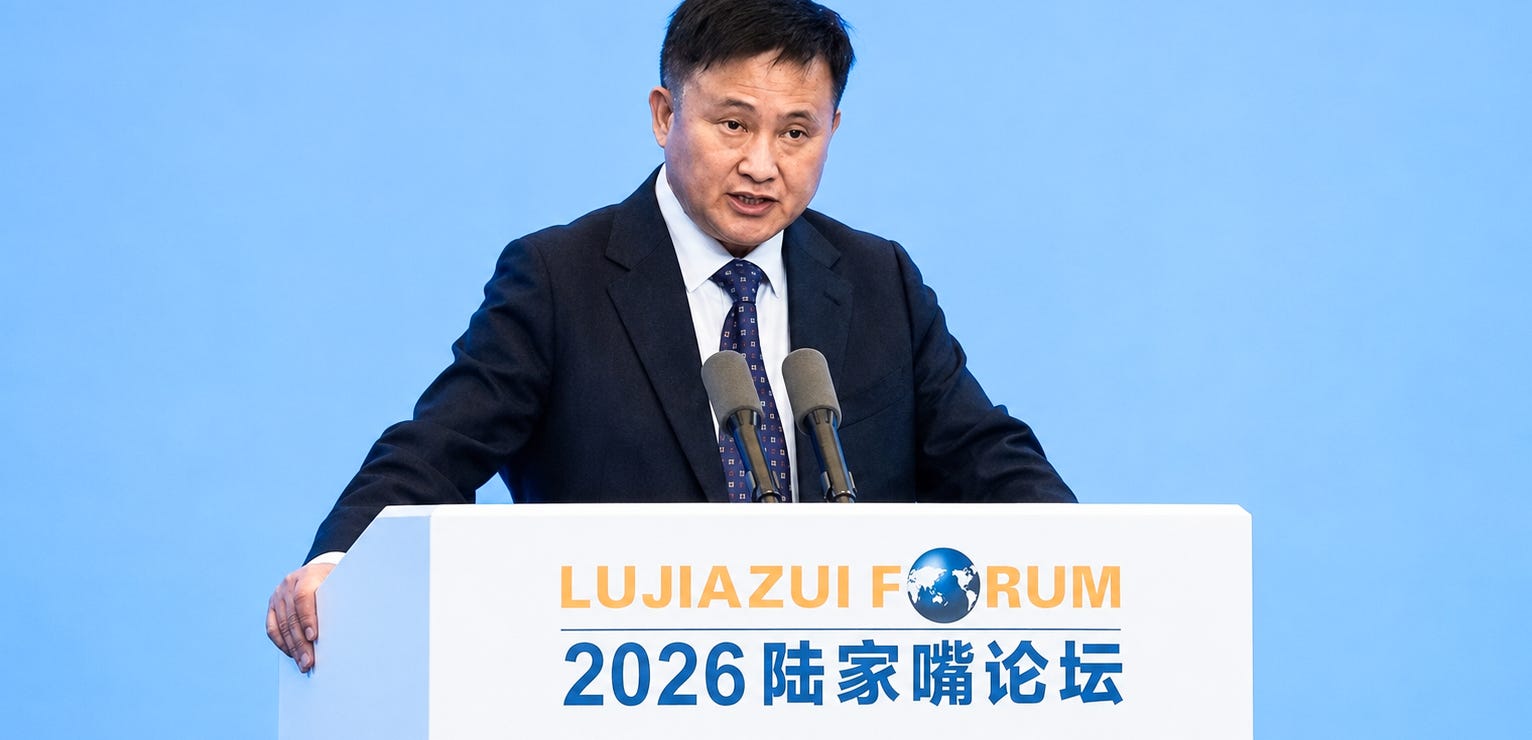
The month’s centrepiece was the coordinated opening package announced at the Lujiazui Forum, the PRC’s flagship annual financial policy summit. It ring-fences an offshore finance layer within Pudong with staged targets through 2035, opening institutions and channels while deferring convertibility: Beijing still pursues a global financial centre without freeing the capital account. This sets Shanghai alongside Hong Kong rather than in its place. A new repo facility allows foreign central banks and sovereign wealth funds to borrow RMB against onshore bonds, nudging the currency towards reserve-currency use.
At home, the push is to turn household savings into equity capital: new rules for actively managed ETFs (exchange-traded funds) and private-fund guidance give savers regulated routes into markets, channelling deposits towards the industries Beijing wants funded, while tightening entry, disclosure and risk control.
The underlying financial structure is shifting too: bond and equity financing supplied 47 percent of new social financing in 2025, overtaking bank loans for the first time, Pan Gongsheng 潘功胜 PBoC (People’s Bank of China) governor noted.
geopol: summits and blueprints
A two-day summit with Kim Jong Un took Xi Jinping 习近平 to Pyongyang on 8 June: his first DPRK visit in seven years. The summit produced no major agreements, yet it capped a striking half-year of summitry: barely a month after hosting Trump and Putin back to back, Beijing is positioning itself as a hub of major-power dealings. On 17 June, the day of the G7 statement on geopolitical issues, it released a 45-page white paper, ‘More Just and Equitable Global Governance’, the fullest statement yet of the global order Beijing wants. Commentators’ attention fell on the 14-point US–Iran ceasefire MOU and a possible European equivalent of the US Section 301 mechanism.
trade: sharper tools
Exports rose 19.4 percent y-o-y in May, driven by AI-related goods, as PRC firms equip the world’s data centres with advanced machinery. US-bound shipments recovered, and the broad competitive strength of PRC goods held. Imports climbed 27.4 percent y-o-y, underpinned by higher input prices in categories including semiconductors and gold. The trade surplus widened to US$105.4bn—the highest since January 2026. Commenting on the surplus, Zhang Yansheng 张燕生 Chinese Academy of Macroeconomic Research advises the PRC to pivot beyond the export-led East Asian model, urging a rethink in trade incentives across exchange-rate formation, FX controls, export tax rebate policies, interest rates, tax, monetary and pricing frameworks.
Export controls widened on a range of fronts. Ten US entities spanning aerospace, defence, drones and rare-earth materials were added to the export control list in retaliation for US restrictions. Tensions with Japan drew a two-tier response: an outright export ban for 20 entities tied to its military build-up, and a watchlist for 20 more.
Controls on strategic mineral-related dual-use items were tightened in enforcement and scope, applying to all destinations. Coverage runs beyond the materials themselves to associated technology, personnel, machinery and know-how, and the rules name the evasion routes: splitting shipments, transhipment through third countries, and transfer through exhibitions, joint R&D or consulting are all now within scope. Violations may be reported publicly, and service providers, from freight forwarders to e-commerce platforms and banks, are pulled into the net.
Beijing is now treating firms’ overseas presence as an extension of the domestic economy. New rules on outbound investment follow this logic, bringing ODI oversight closer to national planning priorities and curbing uncoordinated expansion. Tiered supervision calibrates risk management to investment type, backed by closer monitoring and early warning. The legal toolkit is sharpened too: authorities may investigate overseas investment barriers and impose countermeasures on their findings. The rules also discipline how PRC firms behave abroad: no selling at unjustifiably low prices, no smearing rivals, no bribery or fraud. Price wars exported to third markets invite trade barriers that hurt all PRC firms at once, so the provisions work as a competitiveness intervention, argues Yu Xinding 余心玎 of UIBE (University of International Business and Economics).
Inbound, the target is the barriers foreign firms meet doing business on the ground, ‘beyond market access’. The action plan follows years of sharp FDI declines. Services, finance and medicine are the priorities. Hong Kong and Macao investors gain earlier access to services in mainland China.
industry: policing price wars
Beijing’s campaign against destructive price competition, dubbed ‘anti-involution’, gained enforceable rules in June. Food delivery platforms face draft rules to quell their subsidy wars: no discounts designed to squeeze out rivals, no selling below cost and no pushing the bill onto restaurants or riders. Automakers were called in over ‘irrational’ price-cutting. A draft ‘price supervisor’ regime works the other direction, barring industry associations from recommending prices to their members. Regulators are now watching prices both ways: wars that drive them down ruinously and quiet coordination that pushes them up, with the aim of stepping in before either becomes a fixture of the market.
Property stayed in decline, new-home prices falling for a 35th straight month, though first-tier cities firmed. The structural answer is urban renewal: the 15th 5-year plan targets 115,000 old residential communities and 4,000 urban villages for renovation, with investment above C¥15tn (~US$2.1tn), built around operating assets rather than land sales. New energy vehicles passed 60 percent of retail even as the market shrank; exports remain the industry’s growth engine, and Premier Li Qiang 李强 used Summer Davos to reject the overcapacity framing.
scitech: robots go to work
June’s biggest robotics story is about data. Language models could train on the whole internet; nothing equivalent exists for physical work, and simulation only goes so far. A new national program addresses the gap by sending humanoid robots to learn on the job in factories, warehouses, hospitals and emergency drills, each task generating training data that improves the next generation of machines. Whoever turns this loop fastest sets the pace in embodied AI, and Beijing is now turning it at national scale.
Data regulation matured alongside. Cyberspace Administration of China rules standardise how firms assess data-security risks, while new guidelines set out how financial firms classify the data they hold: international firms gain predictability, regulators firmer grounds for inspection and penalty.
The AI+ agenda reached the network layer: a 2026–28 plan for the communications sector sets the month’s only hard target, one-millisecond compute access across three-quarters of metropolitan areas by 2028; its stress on uplink capacity signals networks built for robots and AI agents rather than for people watching video.
energy: scale to integration
Non-fossil energy should reach 25 percent of consumption by 2030 under the 15th 5-year plan for a new energy system, backed by more than C¥20tn (~US$2.8tn) in investment, over C¥5tn of it for the grid. The headline shift is from scale to integration: storage, grids, flexible demand and market reform now determine whether green power reaches users, while coal stays as a security backstop. The use of renewables became enforceable, with minimum shares for key energy users extending beyond electricity to green hydrogen, ammonia and heating, and nine energy-intensive sectors face end-2028 retrofit deadlines; persistent laggards face closure. Computing is the new load to manage: data centres are projected to take some 6 percent of power demand by 2030.
environment: carbon counts
PRC product carbon footprint accounting is moving from design to use; the first annual progress report shows that footprint data is now used in certification, green procurement and the reports exporters file abroad. The EU explains the urgency. Its carbon border levy CBAM (Carbon Border Adjustment Mechanism) taxes imports on their emissions, and its Battery Regulation demands footprint data as a condition of sale; a PRC-built platform helped 92 exporters compile CBAM filings, and Beijing wants its measurements recognised abroad so PRC exporters are not measured twice. Revised air standards cut the annual PM2.5 limit from 35 to 25 micrograms per cubic metre; only 140 cities comply, and further gains need structural change rather than end-of-pipe fixes.
governance: laws catch up
A batch of draft laws went before NPC (National People’s Congress) Standing Committee from 23 June. The Antarctic Activities and Environmental Protection Law, at second reading, would scale fines to the impact, severity and difficulty of recovery of harm to the Antarctic environment: Beijing formalising compliance to pre-empt criticism that its polar and resource activities outpace its rules. The Government Procurement Law revision, the first overhaul in more than a decade, brings scattered small purchases outside the centralised catalogue into scope and targets hidden barriers.
ag: tech over land
Food security is reframed under the 15th 5-year plan for agricultural and rural modernisation: grain capacity of 725 million tonnes by 2030, with scitech supplying 67 percent of farm-sector growth; future gains are to come from technology, not from more land or labour. Enforcement tightened along the entire food chain: new rules on commissioned and private-label production take effect in December 2026; Walmart China was summoned over failures at Sam’s Club stores; and model court cases paired prison terms with mandatory ecological restoration for illegal dumping and building on farmland.
social policy: biomed and benefits
Large-scale foreign investment in biomedicine is courted by a Shanghai package. Until now, a firm that moved production of a medicine from abroad into the PRC was treated as launching a new product: it had to reapply for approval and risked losing its agreed price and its place in hospital purchasing, a costly deterrent to localising. The package protects both, and cell and gene therapy firms, previously kept outside, may now research and manufacture inside Shanghai’s free trade zone.
For households, the change is to medical savings. Every insured worker holds a personal medical account, but balances could not cross provincial lines, so a migrant worker’s savings were of no use to parents or children enrolled back home. A trial now lets part of the balance transfer to immediate family in any province’s scheme, to cover their bills or premiums.
Platform employers’ obligations firmed under the employment-first 15th 5-year plan: platforms must disclose the algorithms that assign jobs and set pay, work-injury insurance for gig workers rolls out nationwide, and gig workers may now opt in to the Housing Provident Fund, the housing savings scheme they were shut out from for lack of a formal employer.