
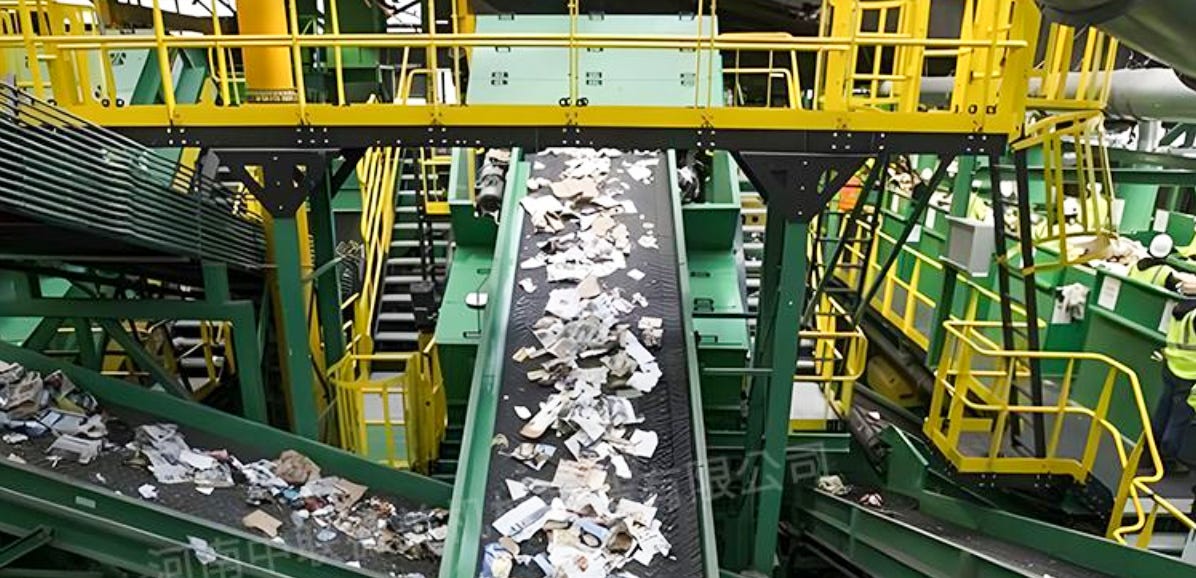
Eight years after banning waste imports, Beijing is seeking to reduce, reuse, and recycle more of its own domestic solid waste.
Highlighting the scale of the challenge, a three-year nationwide campaign against illegal dumping, launched in 2025 by environmental and legal authorities identified 9,000 illegal sites and close to 30,000 infractions.
At the same time, Beijing is stepping up its push to use more recycled materials. An Action Plan launched on 31 December sets out steps to lift demand for recycled inputs. Now, a separate plan on solid waste, co-signed by NDRC (National Development and Reform Commission) and 25 central agencies, aims to tighten control across the whole chain—from cutting waste at source to transfer, collection, use, treatment and final disposal.
Referred to as ‘Ten Measures’, it signals a new era of full-chain solid waste governance, notes Wen Zongguo 温宗国 Tsinghua University School of Environment. Taken together with curbs on air, water and soil, it rounds out Beijing’s policy framework in its fight against pollution, he adds.
targets for 2030 include
achieving notable results in special rectification areas
reaching 4.5 bn tonnes of annual bulk solid waste utilisation
reaching 510 million tonnes of annual renewable resource recycling
effectively controlling historical solid waste stockpiles
Rectification campaigns will launch to target illegal dumping, environmental risks at municipal landfills, and the remediation of historical and phosphogypsum stockpiles.
why now?
The PRC generates 11 bn tons of solid waste per year, making it one of the world’s largest sources.
Solid waste can be divided into industrial, hazardous, household, construction, and agricultural categories, as well as municipal sludge.
Industrial solid waste makes up the bulk. Mining, aluminium smelting and power generation churn out coal gangue, fly ash, gypsum, red mud and tailings. As growth in traditional infrastructure has slowed, stockpiles have swelled. Official estimates put accumulated industrial waste at 33 bn tonnes, spread across thousands of square kilometres.
Solid waste not only takes up scarce land; it also causes grave harm if not handled and disposed of with care. Unlike air or water pollution, it is harder to tackle. Its sources are scattered, its make-up complex, and the risks it poses are often hidden. For example, solid waste pollutants leach into soil, water, or air, affecting both ecosystems and public health. They are less visible than other forms of pollution.
Solid waste governance has been weak, even as air and water quality have improved, says Li Gao 李高 MEE (Ministry of Ecology and Environment) vice-minister. While overall reuse of bulk industrial solid waste has reached nearly 60 percent, historical stockpiles show no signs of shrinking and gaping holes in governance remain. Illegal dumping of construction, household, and industrial waste has not been curbed, leading to both ecological damage and black-market profits, Gao adds.
changing logic of solid waste
Beijing’s latest Action Plan attempts to address these gaps, while advancing three major strategic shifts, according to Liu Zhengang 刘振刚 Chinese Academy of Science Research Centre for Eco-Environmental Sciences.
The plan outlines transitions from
end-of-pipe passive disposal to whole-process management
fiscal subsidies to market-driven mechanisms
traditional pollution control to integrated reduction of both pollutants and CO₂ emissions
Solid waste governance is to be fully integrated into the PRC green low-carbon agenda.
The plan puts forward clear guidelines for source reduction, process control and resource use, notes Zhou Haibing 周海兵 NDRC (National Development and Reform Commission). At the same time, by developing a circular economy and fully tapping the resource potential of solid waste, it shows that it is possible to turn waste into value and harm into benefit, he notes.
This is reflected in the plan’s mention of securing high-value renewable resources both at home and abroad, including rare metals derived from the growing waste from ‘new three’ products (i.e., batteries, solar panels, and electric vehicles).
Such efforts are likely to be headed by the recently launched central state-owned enterprise for resource recycling, set-up to spearhead national recycling initiatives.
This SOE, China Resources Recycling Group, has said it will focus on building a circular economy in wind, solar PV, energy storage and thermal energy. The goal is to become a global leader in the recycling and reuse of new energy components. But key challenges remain: chief among them is the enormous technical and economic cost of recycling complex goods.
who pays?
While the PRC has adopted a polluter-pays principle, the reforms seek to outline both carrots and sticks. Extended producer responsibility (making producers responsible for the entire lifecycle of their products) will apply to electronics and batteries, signifying a push for greater environmental compliance.
Fiscal support will continue alongside more green finance vehicles and a new pricing mechanism to boost greater private investment.
Transforming waste into ecological assets is a priority. Green procurement of recycled products by the state will grow, while clearer product carbon footprint certification and emissions cuts linked to voluntary carbon trading will also be explored for recycled materials.
One major innovation is a rule that local governments allocate at least 1 percent of industrial land for resource recycling and reuse. This would provide much-needed land for circular economy development and unlock a common bottleneck, says Guo Yungao 郭云高 All-China Federation Energy and Environment Committee secretary general. But how feasible is this for cash-strapped local governments?
Large-scale resource recycling should proceed with caution, contends Chang Jiwen 常纪文 State Council DRC. He recognises the economic pressures local governments face. Cases in point are the falling demand for recycled building materials due to the real estate downturn, which has led some firms to resort to illegal dumping. In some regions; coal gangue reuse firms have low technical standards and poor management, leading to significant air pollution, Chang notes.
towards a zero-waste system
Under its ecological civilisation banner and its action to build a ‘Beautiful China’, solid waste governance is laying the foundations for a zero-waste system.
New circular economy models are being piloted at the city-level through zero-waste city initiatives. Solid waste indicators are also part of green and zero-carbon factories.
At the firm level, businesses should form zero-waste groups to minimise waste and standardise disposal, notes Wen. Zero-carbon factories will then be the key unit for driving innovation, backed by advanced tech-enabled monitoring, he adds.
Yet the PRC solid waste pile—11 billion tonnes generated annually, 33 billion tonnes already stockpiled—represents an environmental challenge of colossal proportions. Dramatic improvements in air and water quality have already been delivered, but closing the loop on Beijing’s solid waste challenge will not respond to ambitious targets and institutional reform without sustained investment and enforcement over decades. Beijing is serious about tackling the problem—but can the scale of action match the scale of the challenge?
recycling experts
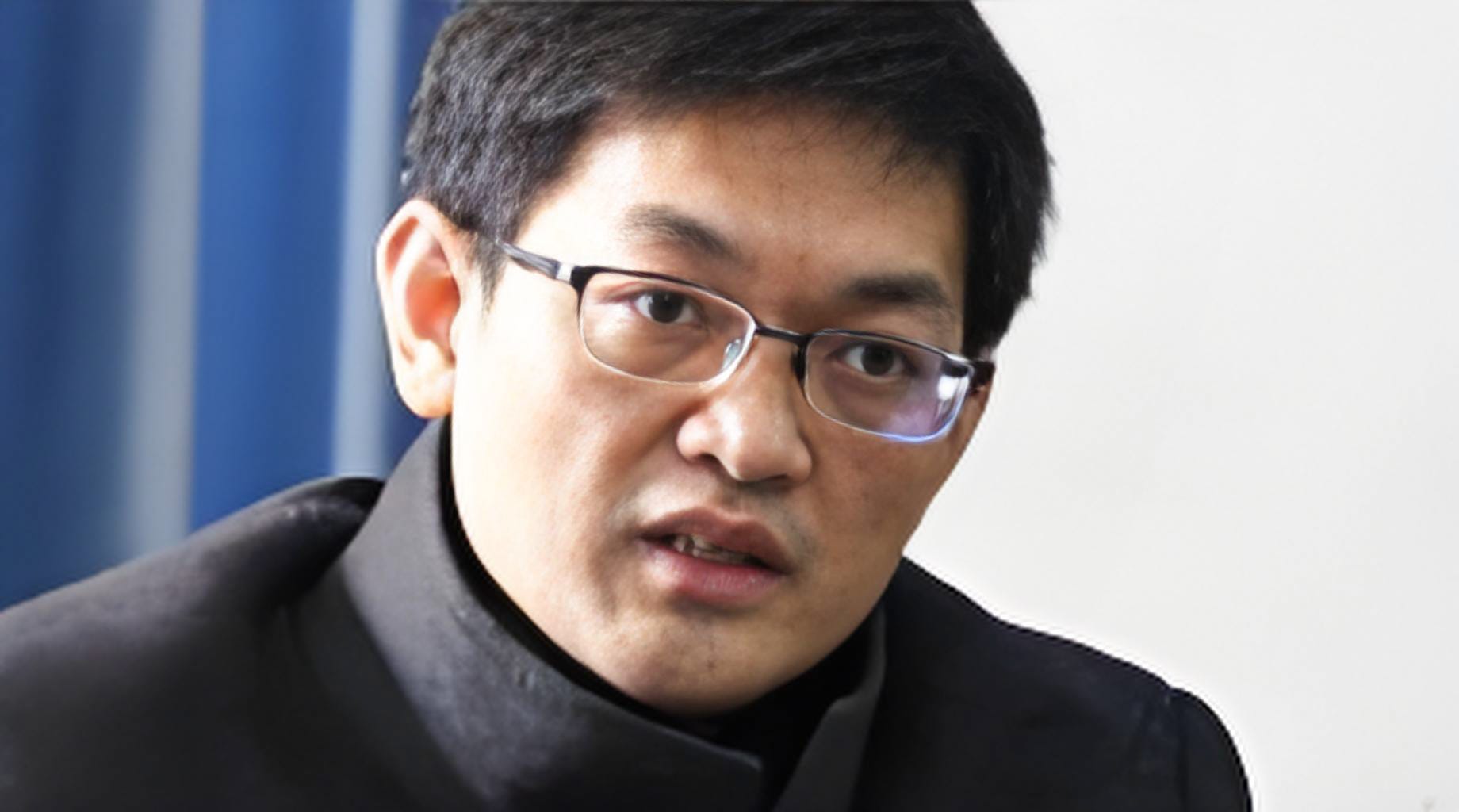
Wen Zongguo 温宗国 | Tsinghua University Circular Economy Industry Centre director
The new measures mark a new phase in full-chain solid waste governance, Wen notes. Together with policies targeting air, water and soil, they complete the PRC’s anti-pollution framework. The circular economy is emerging not only as a systemic pathway to higher resource efficiency, but as a critical lever for cutting emissions in hard-to-abate sectors.
As conventional mitigation approaches its limits, resource circulation offers fresh decarbonisation potential. Yet challenges include a high volume of solid waste-related legal cases and persistently low recycling rates across several waste streams.
In response to new trends such as slowing urbanisation, increasingly complex waste composition and rapid growth of retired renewable energy tech, solid waste recycling must shift from scale expansion to quality enhancement. Wen identified three key tech-enabled pathways
strengthening regulation and monitoring through ‘space-air-ground’ integrated sensing system combining satellite remote sensing, unmanned drones and ground based censors
improving recovery efficiency of low-value recyclables through AI-enabled terminal sorting and shifting sorting capacity to downstream facilities
advancing multi-type solid waste treatment and utilisation through shared park-based facilities and energy-material coupling
Advising state agencies on major green policies, Wen has led national and local research, including Suzhou’s circular economy technology. He helped draft several plans for rolling out low-carbon and ecological civilisation industrial bases and circular economy demo cities.
Chang Jiwen 常纪文 | State Council DRC (Development Research Centre) Institute of Resources and Environment vice director
Solid waste resuse should advance in a prudent and phased manner, Chang argues. For waste streams that are currently difficult to process or lack economic viability, interim solutions such as sanitary landfilling or ecological disposal—including mine or pit backfilling—may be appropriate, with resource recovery revisited as technological and market conditions improve.
From a regulatory perspective, technological innovation and deployment are pivotal. Intelligent, data-driven systems must be leveraged to ensure full-process traceability and control—from source generation and transport to treatment, disposal and recycling.
A legal authority, Chang has helped draft over thirty environment and resource laws, including the 2011 Air Pollution Prevention and Control Law and the 2013 Climate Change Abatement Law.